You are three weeks into something that will not settle. The job, the city, the family arrangement. You are not in crisis. You are just never quite on the ground, and every morning starts from slightly behind.
That feeling is what sends people to a gesture called prithvi mudra. Here is what it is, exactly how to hold it, why it keeps getting confused with a gesture meant to do the opposite, and what the tradition claims for it.
What prithvi mudra is
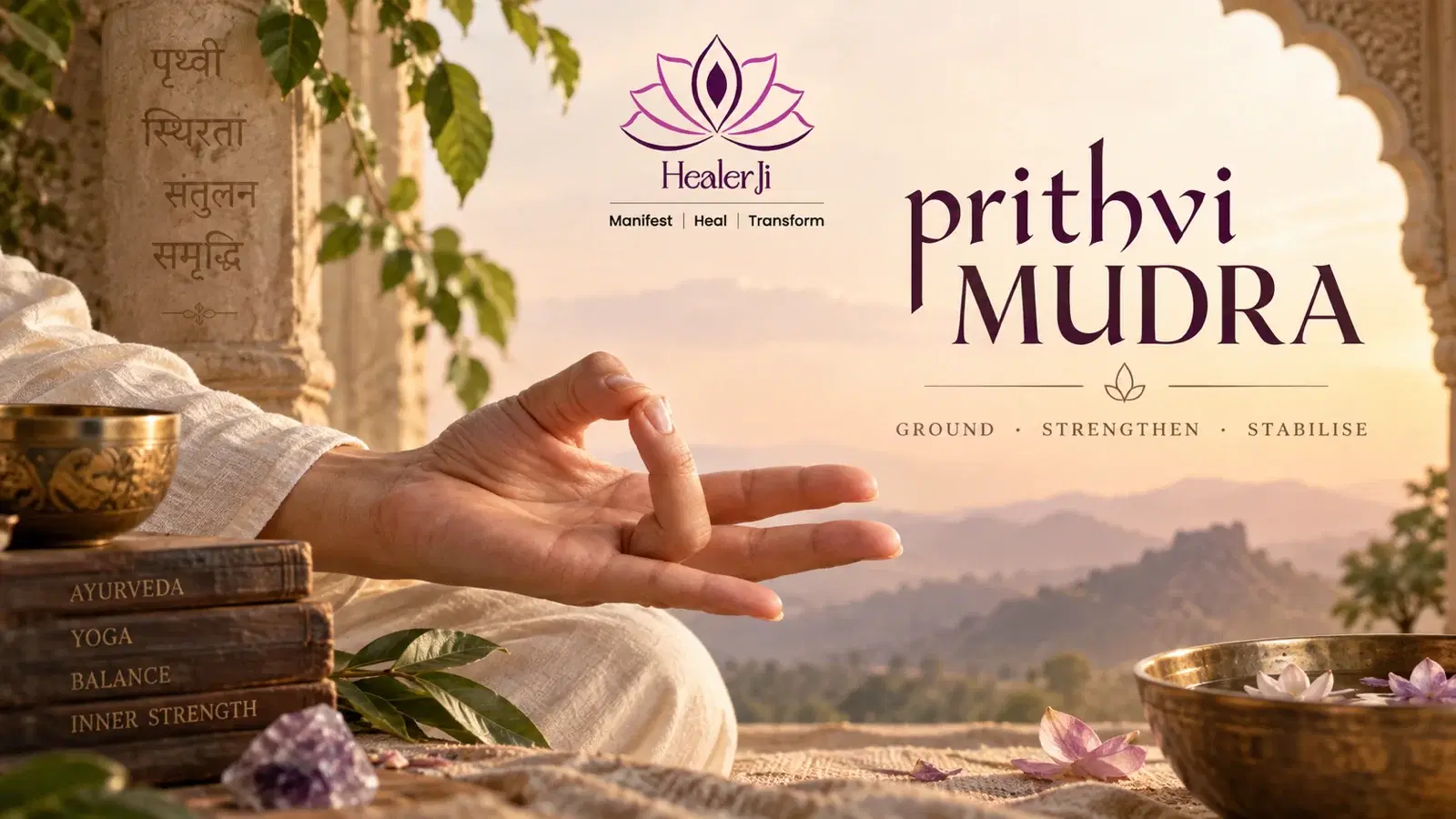
Prithvi mudra is a seated hand gesture in which the tip of the ring finger rests against the tip of the thumb, with the other three fingers extended and relaxed. In Sanskrit, pṛthvī means earth. You will also see it written pruthvi mudra, prithivi mudra, or in Devanāgarī as पृथ्वी मुद्रा.
The reasoning behind it is a mapping. In the five-element scheme used across modern hasta mudrā teaching, each finger carries one of the pañca tattva: the thumb is fire, the index finger air, the middle finger space, the ring finger earth, and the little finger water. Touch two fingers together and you are said to be adjusting the balance between two elements. Ring finger to thumb brings earth into contact with fire, and the gesture is described as increasing earth: weight, density, steadiness, the quality of being held down rather than blown about.
Worth saying early, because it changes how you read everything after it: that finger-to-element mapping is modern. The mudrā chapters of the classical haṭha manuals, the Haṭha Yoga Pradīpikā and the Gheraṇḍa Saṃhitā, describe something else entirely, whole-body practices and locks like mahāmudrā, khecarī and viparīta karaṇī. The tidy system of ten or twenty finger gestures, each assigned an element, is set out in twentieth-century books on hasta mudrā and in the Indian naturopathy and acupressure literature that grew alongside them, and lineages do not agree on the details. Some teachers swap the water and space fingers. Some give prithvi mudra a different name altogether.
How to hold prithvi mudra, step by step
No image required. It is easier than any diagram makes it look.
- Sit down. On a chair with your feet flat, or cross-legged on the floor. Spine upright but not held rigid. This is meant to be comfortable for several minutes.
- Rest your hands on your thighs or your knees, palms facing up. Both hands do the same thing.
- Bring the tip of your ring finger to the tip of your thumb. The tip, not the pad, and not the nail. They meet and rest there.
- Keep the contact light. The two fingers should form a ring you could pass a coin through, not a pinch. If your forearm is working, you are gripping.
- Let the other three fingers extend. Index, middle and little stay straight and soft, slightly apart. Not splayed, not stiff, not curled in.
- Soften the shoulders and let the breath go low and slow. Nothing elaborate. Just longer out than in, which the root centre work tends to ask for anyway.
- Stay for five minutes to begin with. The commonly taught figure is fifteen to thirty minutes a day, split across sittings if you like. Five minutes done regularly beats thirty minutes done once.
When you stop, release the fingers slowly and sit for a breath before standing up. Not because anything dramatic has happened, but because standing up straight out of stillness is how a good five minutes gets wasted.
The ring finger is the one you have least independent control over, which is part of why this gesture rewards a light touch. For the first few sittings it will want to drift. Bringing it back is not an interruption of the practice. It is the practice.
The mix-up: prithvi mudra and surya mudra
This is the thing most likely to send you home with the wrong gesture.
Prithvi mudra and surya mudra use the same two fingers. They are not variations of each other. The tradition treats them as opposites.
Prithvi mudra: ring fingertip meets the thumb tip. Said to increase the earth element.
Surya mudra: the ring finger folds down so its tip touches the base of the thumb, and the thumb rests lightly on top of it. Said to reduce earth and raise fire. It is sometimes called prithvi-shamak mudra, the earth-calming gesture, which tells you exactly what it was meant to counter.
So when you read that prithvi mudra is associated with weight gain and surya mudra with weight loss, that is not two different claims from two different traditions. It is one symbolic system being applied in two directions. Plenty of people are holding one while meaning the other, and if you are going to hold one, hold the one you meant to hold.
Prithvi mudra and the root chakra
Pṛthvī is the element assigned to mūlādhāra, the root chakra, which tradition places at the base of the spine and associates with safety, belonging, and the sense that the ground will hold you. That is the reason a gesture for the earth element gets recommended for root chakra work. If the chakra map is new to you, we have written all seven up with their Sanskrit, their seed sounds and their traditional correspondences at the root chakra and across the chakras.
Two things worth being clear about.
Prithvi mudra and mūlādhāra mudrā are different gestures. The names get used interchangeably and they are not the same thing. Mūlādhāra mudrā, the one named on our own root chakra page, interlaces the hands with the thumbs and index fingers joined, resting in the lap. Prithvi mudra is the ring finger and thumb, each hand on its own. Prithvi reaches the root through the element; mūlādhāra is named for the centre itself. Either is a reasonable thing to do. Pick one and know which one you picked.
A chakra is not a diagnosis. Nothing about a hand position tells you that a centre is blocked, and nobody who has just met you can tell you that either. The chakra map is useful the way a good metaphor is useful: it gives a name to a felt state and a place to put your attention. We have written that out in full in chakras, a map not a diagnosis.
What the tradition claims
In the mudrā literature, prithvi mudra is associated with strength and stability in the body, with confidence and clarity of mind, with relief from fatigue, with digestion, with the growth of tissue and the strength of bones, and with the condition of hair and skin. In Hindi writing on the subject the last of those usually comes first: the glow of hair and skin.
These are traditional associations rather than tested effects, and they are worth holding as what they are. The symbolic logic that produces the list is the same logic that produces the element chart above: more earth, therefore more substance, therefore bone and tissue and steadiness. It is coherent inside its own system. It has not been measured outside it.
What remains when you set the list aside is not nothing, and it is not mysterious either. You sat down. You stopped moving. You put your attention on one small physical point and kept it there for several minutes while breathing slowly. People have done that on purpose for a very long time because of how it leaves them, and a mudrā is a sincere and portable way of doing it.
Side effects, and the caution the tradition makes about itself
Resting a ring finger against a thumb is not known to harm anyone. If your hand cramps or your wrist aches, you are holding too tightly or sitting for too long. Ease off. That is the whole of the physical caution.
The tradition offers one of its own, which is worth reporting because it is unusually specific. Because prithvi mudra is said to increase the earth element, the mudrā literature commonly advises against it for anyone trying to lose weight, and sends them to surya mudra instead. Take that as what the tradition says rather than as a physiological fact.
One practical note. Fatigue that will not lift, hair loss, weight lost without trying and bone pain are all signs with causes a doctor can look for, and they are worth investigating whatever else you also do. Practise alongside that, not instead of it.
What prithvi mudra is not
It is not a treatment, and it will not steady a life that is genuinely unstable. Grounding practice helps you meet an unsettled stretch. It does not settle it. If the ground is actually moving, part of the answer is practical, and no gesture substitutes for the practical part.
It is also not a daily obligation. If you find yourself anxious about having missed your fifteen minutes, the practice has turned into another thing to fail at, and the fix is to shorten it rather than to try harder. The gesture is a place to put your hands while you do something else: sit still, breathe slow, stay with one point. Held while scrolling, it is a hand shape.
If you have five minutes and you would rather have a voice guiding it than a position to remember, grounding in five minutes brings attention back to the body one sense at a time. It is free, needs nothing, and works at 11 pm.
Where a healer fits, and where they do not
Everything above you can do alone tonight, for nothing. Most people should start exactly there.
A session is for when you have been doing it alone and it is not landing: when you want somebody to sit with the unsteadiness rather than hand you a list, or when you want the wider practice rather than one gesture from it. On HealerJi, chakra healing is guided work across the seven centres using breath, sound and attention, and its own page says what it is not: not a diagnosis of anything physical, a map for self-reflection held within a living tradition. You can read the wider family of practices at energy healing, or start from the body instead at health and vitality. If what is underneath the restlessness is heavier than restlessness, our crisis resources are here.
Sessions run over chat, audio or video, in the language you think in. For a subject like this one it matters more than it sounds. The words many Indian families reach for here are pṛthvī tattva, mann nahin lag raha, pair zameen par nahin hain, and those are easier said in the language they were learned in than translated for a stranger. Prices are set by each healer and shown before you pay.
A healer is a complement to medical and mental-health care. Never a replacement for either.
The gesture will not anchor your life. It will give you five minutes a day where your hands know what they are doing, and on a week where nothing else does, that turns out to be a reasonable place to start.