There is a particular kind of flat that is hard to describe to anyone. Not sadness, and not quite burnout. Nothing in you is moving. The things you used to want, you no longer especially want, and you are not even upset about that. You have been in the stretch long enough to stop mentioning it.
That is the feeling the water element in this tradition is actually about, and it is not usually where a conversation about varun mudra starts. Here is what the gesture is, exactly how to hold it, what the water element stands for in the tradition that named it, and what the tradition claims for your skin.
What varun mudra is
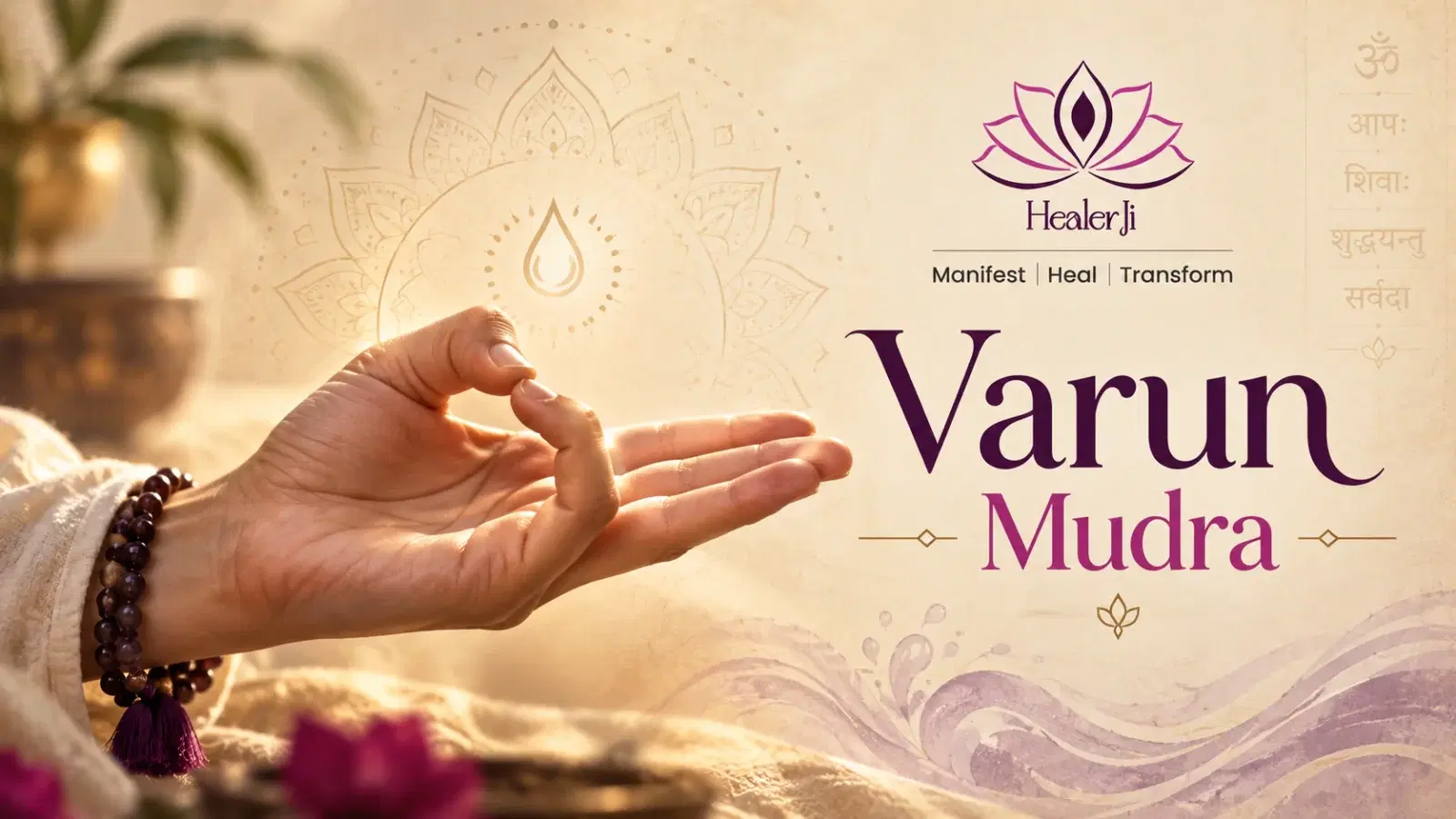
Varun mudra is a seated hand gesture in which the tip of the little finger rests against the tip of the thumb, with the other three fingers extended and relaxed, in both hands at once. It is named for Varuṇa, the Vedic deity of the waters, one of the oldest gods in the Ṛgveda and the keeper of cosmic order before that role passed elsewhere. You will also see the gesture called jala mudra, jal vardhak mudra (the water-increasing gesture), varuna mudra, or in Devanāgarī वरुण मुद्रा.
The reasoning behind it is a mapping. In the five-element scheme used across modern hasta mudrā teaching, each finger carries one of the pañca tattva: the thumb is fire, the index finger air, the middle finger space, the ring finger earth, and the little finger water. Touch two fingers together and you are said to be adjusting the balance between two elements. Little finger to thumb brings water into contact with fire, and the gesture is described as increasing water: moisture, flow, the quality of moving rather than sitting still.
That finger-to-element chart is modern, and it is worth saying so before anything is built on it. The mudrā chapters of the classical haṭha manuals describe whole-body practices and locks, not a tidy system of finger positions with an element attached to each. The chart comes from twentieth-century books on hasta mudrā and the Indian naturopathy and acupressure literature that grew alongside them, and lineages disagree on the details. We wrote that out at length in prithvi mudra, and it applies equally here.
How to hold varun mudra, step by step
- Sit down. A chair with your feet flat, or cross-legged on the floor. Spine upright and not held rigid. This should be comfortable for several minutes, because several minutes is the point.
- Rest your hands on your thighs or your knees, palms facing up. Both hands do the same thing.
- Bring the tip of your little finger to the tip of your thumb. The tip, not the pad, and not the nail. They meet and rest there.
- Keep the contact light. The little finger is the weakest one you have, and it is easy to overcorrect by gripping. Think of it as touching, not holding.
- Let the other three fingers extend. Index, middle and ring stay straight and soft, slightly apart. The ring finger will want to follow the little finger down. Let it stay out.
- Soften the shoulders, and let the breath move low. Svādhiṣṭhāna work traditionally asks for breathing that lets the belly move freely, wave-like rather than counted. Nothing elaborate.
- Stay for five minutes to begin with. The commonly taught figure is twenty to thirty minutes a day, split across sittings if you like. Five minutes done regularly beats thirty minutes done once and abandoned.
When you stop, release the fingers slowly and sit for a breath before standing. Not because anything dramatic has happened, but because standing straight up out of stillness is how a good five minutes gets spent for nothing.
Of the four fingers, the little one is the hardest to hold out on its own, and this gesture asks it to do something unfamiliar while the ring finger tries to come with it. That settles within a week. Until it does, a lighter touch is more useful than a more determined one.
Varun mudra and jal shamak mudra: the pair
Varun mudra has an opposite, and the opposite uses the same two fingers. This is the thing most likely to send you home with the wrong gesture.
Varun mudra: little fingertip meets the thumb tip. Said to increase the water element. Hence jal vardhak, water-increasing.
Jal shamak mudra: the little finger folds down so its tip touches the base of the thumb, and the thumb rests lightly on top of it. Said to reduce the water element. It is also called jalodar nashak mudra, and it is what the same literature recommends when it reads the problem as too much water rather than too little.
So when you read that one gesture is for dryness and the other for swelling, that is not two traditions disagreeing. It is one symbolic system being applied in two directions. If you are going to hold one, hold the one you meant to hold.
Varun mudra and the sacral chakra
Water, āpas, is the element tradition assigns to svādhiṣṭhāna, the sacral chakra, placed roughly two finger-widths below the navel. That is the reason a gesture for the water element gets recommended for sacral work. You can read the centre in full, with its Sanskrit, its seed sound and its traditional correspondences, at the sacral chakra, and the other six at the chakras.
Two things worth being clear about.
The mudrā our own sacral page names is a different one. That page names śakti mudrā, not varun mudra. Both get attached to svādhiṣṭhāna and they are not the same gesture. Varun mudra reaches the centre through the element it is said to govern. Śakti mudrā is named for the force itself. Either is a reasonable thing to sit with. Know which one you picked.
What the water centre is traditionally about is feeling, not moisture. Svādhiṣṭhāna is described as the centre of flow, desire, creativity and the willingness to feel, and the states tradition associates with it going quiet are flatness, numbness and creative dryness: the kind of dryness you would describe to a friend rather than to a dermatologist. That is the tradition's own reading of water, and it is the more interesting one. Somewhere along the way a symbol about emotional flow became a claim about your face.
And a chakra is not a diagnosis. Nothing about a hand position tells you a centre is blocked, and nobody who has just met you can tell you that either. We have written that out in full in chakras, a map not a diagnosis.
What the tradition claims, and the skin question
In the mudrā literature, varun mudra is associated with moisture and complexion, with the balance of fluid in the body, with the blood, with digestion, and with a general quality of suppleness rather than stiffness. Skin is almost always named first.
These are traditional associations rather than tested effects. The logic that produces them is symbolic and consistent: more water, therefore more moisture, therefore skin, blood and flow. That is coherent inside its own system, and it has not been measured outside it.
It is worth adding the plain version, because it is the question most people actually arrived with. Your body's water balance is managed by your kidneys and by hormones that respond to how concentrated your blood is, and it is a tightly regulated system. If you are thirsty, drink water. If your urine is consistently dark, drink more. Persistent thirst, passing far more water than usual, or fluid held so that your ankles or fingers swell are all worth seeing a doctor about, because the common causes are all things worth finding early.
What remains when you set the claims aside is not nothing. You sat down. You stopped moving. You put your attention somewhere specific and kept it there for several minutes. People have done that on purpose for a very long time, and a mudrā is a sincere and portable way of doing it.
Precautions, and the caution the tradition makes about itself
Varun mudra is unusual among these gestures in that the tradition cautions against itself, and the caution is specific enough to be worth reporting. Because the gesture is said to increase the water element, the mudrā literature commonly advises against practising it when the body is already holding fluid, when there is swelling or puffiness, during a cold, and for constitutions it reads as already damp. It sends those readers to jal shamak mudra instead.
Take that as what the tradition says rather than as a physiological fact. But a tradition that names the situations where its own practice is the wrong choice is being careful with itself, and that is worth noticing.
Beyond that, the physical caution is small. If your little finger cramps or your wrist aches, you have held it too long or too tightly. Ease off.
What varun mudra is not
It is not a treatment, and it does not hydrate you. Water does that, and the distance between those two sentences is worth keeping in view.
It is not a way to feel things again on a schedule either. Numbness that has settled in usually arrived for a reason, and the reason is generally not an element. A practice can give the feeling somewhere to arrive. It cannot summon it.
And it is not a daily obligation. If you are anxious about having missed your twenty minutes, the practice has become another thing to fail at, and the fix is to shorten it rather than to try harder. The gesture is a place to put your hands while you do something else: sit still, breathe low, stay with one point. Held while scrolling, it is a hand shape.
If you would rather have a voice guiding you than a position to remember, nine minutes of breath is a Swar Vigyan practice that starts with observation rather than control. It is not a sacral practice and we will not pretend it is one. It is free, needs nothing, and works at 11 pm.
Where a healer fits, and where they do not
Everything above you can do alone tonight, for nothing. Most people should start exactly there.
A session is for when you have been doing it alone and it is not landing: when the flatness has outlasted your patience with it, or when you want the wider practice rather than one gesture lifted out of it. On HealerJi, chakra healing is guided work across the seven centres using breath, sound and attention, and its own page says plainly what it is not: not a diagnosis of anything physical, a map for self-reflection held within a living tradition. You can read the wider family of practices at energy healing, start from the body at health and vitality, or start from the feeling at emotional wellbeing. If the flatness is heavier than flatness, our crisis resources are here.
Sessions run over chat, audio or video, in the language you think in. For this one it matters more than it sounds. The words Indian families actually reach for here are mann nahin lag raha, kuchh accha nahin lagta, sab kuchh sookha sa hai, and those are far easier said in the language they were learned in than translated for a stranger. Prices are set by each healer and shown before you pay.
A healer is a complement to medical and mental-health care. Never a replacement for either.
The gesture will not moisturise anything. It will give you five minutes a day in which your hands are doing one small, deliberate thing, and in a flat stretch, five deliberate minutes is more than the day was otherwise going to offer.